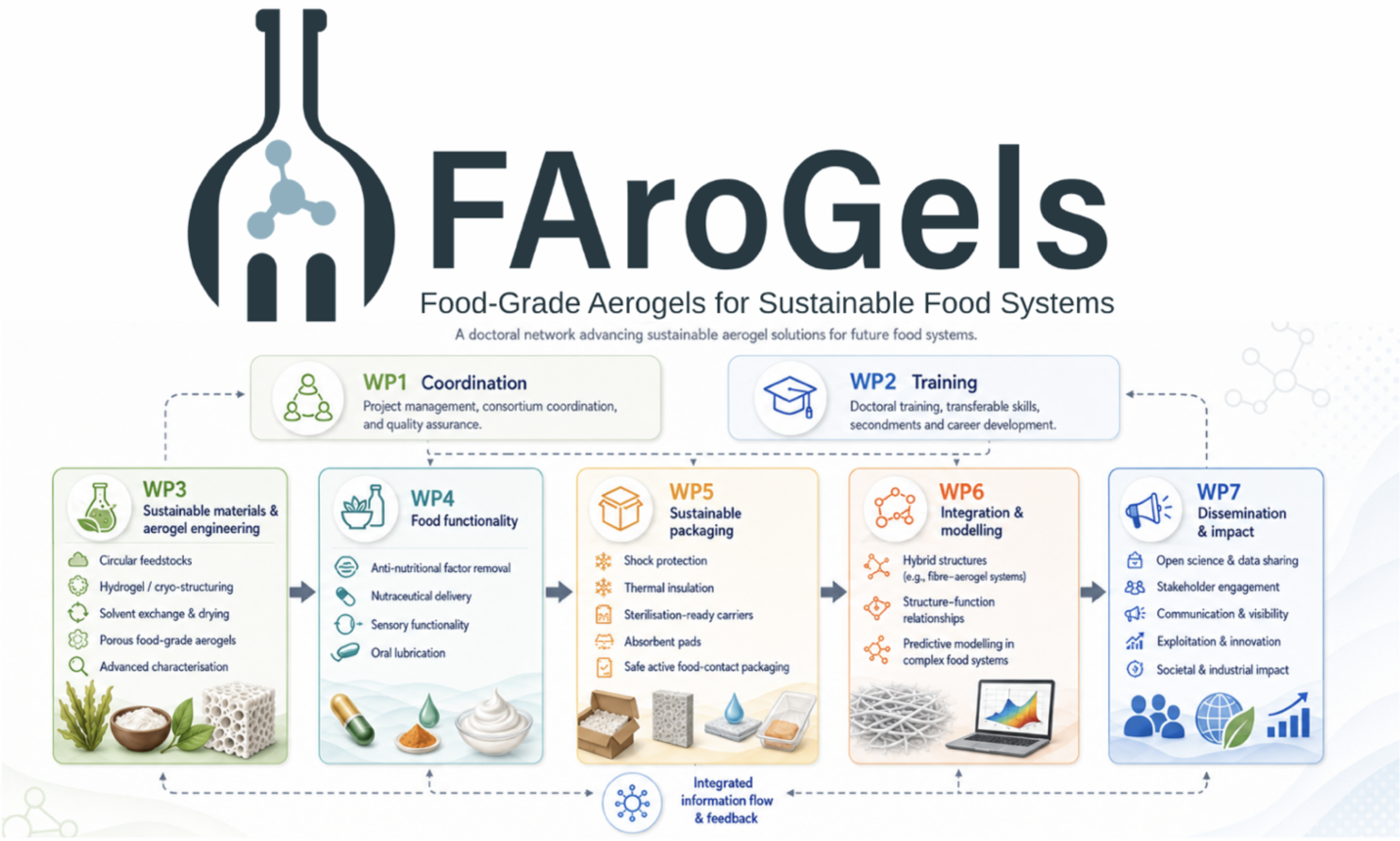
FAroGels – Food‑Grade Aerogels for Sustainable Food Systems has been selected for funding as a Marie Skłodowska‑Curie Actions (MSCA) Doctoral Network under the EU’s Horizon Europe programme. In a highly competitive call, FAroGels has become the first MSCA Doctoral Network coordinated from Türkiye, with Middle East Technical University (METU) serving as the coordinating institution, marking a significant milestone for the country’s role in the European Research Area. The 4-year project has a total budget of €4.189.370,04, fully funded by the European Commission.
Aerogels are extremely light, highly porous materials that are already used for insulation and in biomedical applications. However, their use in food is still limited to initial proof-of-concept studies. FAroGels project aims to move the field forward by developing biodegradable, edible aerogels from circular, bio-based feedstocks, and by implementing clear guidelines for their safe and effective use in real food systems.
FAroGels will focus on the use of food-grade aerogels in everyday's food applications: The project will explore ways to make plant-based foods easier to digest, transport vitamins and other beneficial ingredients effectively, improve the texture and smoothness of low-sugar or low-fat products, and keep fruit, vegetables and meat in better condition during storage and transport. By studying these kinds of practical scenarios, FAroGels aims to develop clear guidelines for designing safe and reliable aerogel materials for use in real industrial settings, which will help to move food systems towards more sustainable options.
The 4-year project will begin on 1 January 2027, supporting 15 doctoral candidates working on the next generation of food-grade aerogels. FAroGels is a collaboration between 23 organisations from 8 countries, including universities, research centres, and companies specialising in food engineering, materials science, biotechnology, and aerogel technology. This international network will provide the DCs access to advanced laboratories, pilot-scale facilities, and industrial real-world challenges.
In this environment, 15 doctoral candidates will undertake a joint training programme combining local doctoral curricula with network training schools, intersectoral secondments, and additional modules on sustainability, entrepreneurship, intellectual property, open science, and responsible research practices. This integrated approach will empower graduates with scientific expertise and labour-market-relevant transferable skills.