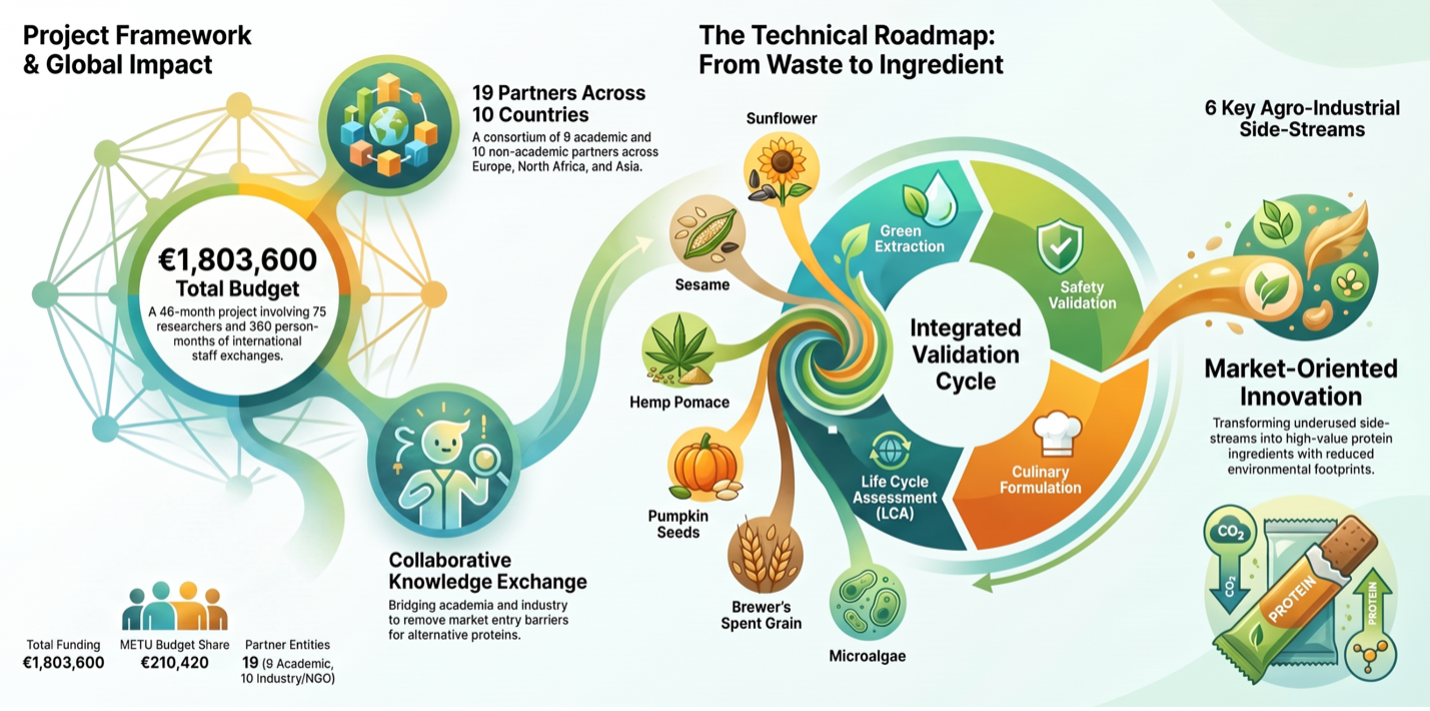
Fix-APro project, coordinated by Middle East Technical University (METU), was officially selected for funding in early 2026 under the European Union’s Horizon Europe Marie Skłodowska-Curie Actions (MSCA) Staff Exchanges scheme. With an official start date set for 1 November 2026, the project will establish an international research and knowledge-exchange network dedicated to improving the sustainable use, safety and functional performance of alternative protein ingredients in food systems. The consortium will hold its official Kick-off Meeting on 3-4 December 2026 at METU in Ankara.
With a total budget of €1,803,600, the 48-month project allocates €210,420 directly to METU as the coordinating institution. The project brings together 19 partners from 10 countries: Türkiye, Spain, Italy, Portugal, Greece, Germany, Romania, Ireland, Malta and non-EU partner countries (Jordan, Morocco, Egypt, India). The consortium comprises 9 academic partners and 10 non-academic partners (industrial leaders, SMEs and NGOs). Alongside METU, Turkish partners include Özyeğin University, TAT Gıda, YAYLA Agro and the Plant-Based Foods Association (BITKIDEN). The project will involve 75 researchers in a total of 360 person-months of international and intersectoral staff exchanges.
Fix-APro will investigate six underutilized agro-industrial side-streams (sunflower meal, sesame seed meal, hemp pomace, pumpkin seed residues, brewer’s spent grain (BSG) and microalgae) using innovative extraction and processing technologies. The resulting alternative protein ingredients will be evaluated in terms of extraction efficiency, reduction of anti-nutritional factors, allergenicity, microbiological safety, sensory and functional performance, environmental sustainability, consumer acceptance and regulatory compliance.
By connecting green extraction, safety validation, culinary-driven product formulation, pilot-scale validation, life cycle assessment (LCA) and regulatory roadmaps, Fix-APro aims to transform underused side-streams into high-value protein ingredients. Through this integrated approach, the project is expected to generate strong scientific, environmental, societal and economic impact by removing market entry barriers for alternative proteins, developing healthier foods and reducing the environmental footprint of protein production. It will also strengthen international knowledge transfer, academia–industry collaboration, intellectual property generation and market-oriented innovation.